Hatha Joga. Jogos pagrindai.

Pakeisk save ir pasaulis aplinkui pasikeis

Skyrius:

Pranayama

Meditacijos pagrindai. Ką pageidautina žinoti

Kas yra klasikinė joga

Kaip prisiminti praėjusius gyvenimus

Kaip teisingai kvėpuoti. Kvėpavimo technikos

Produktai organizmo valymui

Pranayama Nadi Shodhana. Stage 3

The inner retention of breath is callen many names in Sanskrit: it is known as antar, antaranga, abhyantara or poorna kumbhaka. We will adopt the name antar kumbhaka, where the word antar means ‘inner’ and kumbhaka means ‘breath retention’. In other words, antar kumbhaka is the practice where the breath is held inside the lungs.

Scriptural references

Kumbhaka is widely mentioned in the ancient yogic texts for it is a very important practice. The ancient text called the Hatha Yoga Pradipika in particular, discusses it a great length. The following are a few extracted quotations: “He who can do kumbhaka for some time will increase digestive fire and hear the internal cosmic sound (nada).… skaityti daugiau


Pranayama Nadi Shodhana. Stage 2

This is an important practice and is mentioned in a large number of ancient yogic texts. The following from the Gheranda Samhita is the most direct reference: “Inhale through the ida (left nostril) and exhale through the pingala (right nostril). Then inhale through the pingala and exhale through the chandra (left nostril). The pooraka (inhalation) and the rechaka (exhalation) should be done without the slightest hurry. This practice will help to eliminate the problems of cough and cold.” (57 & 58)

Technique

Stage 2

1. Sit in a comfortable sitting position. Sukhasana or vajrasana are most suitable for this purpose, together with other meditative asanas.
2. Be calm and relax your whole body.… skaityti daugiau


Pranayama Nadi Shodhana. Stage 1

pranayama-techniques-benefits-types-step-by-step-for-beginners

The sanskrit word nadi means ‘psychic passage’ or ‘specific pathway’ through which prana flows throughout the body The word shodhana means ‘purification’. Thus this is a practice whereby the pranic pathways are purified and decongested. This allows the prana to flow freely throughout the body bringing the physical body into the best possible health and calming the mind. It is an excellent preparation for meditation techniques.

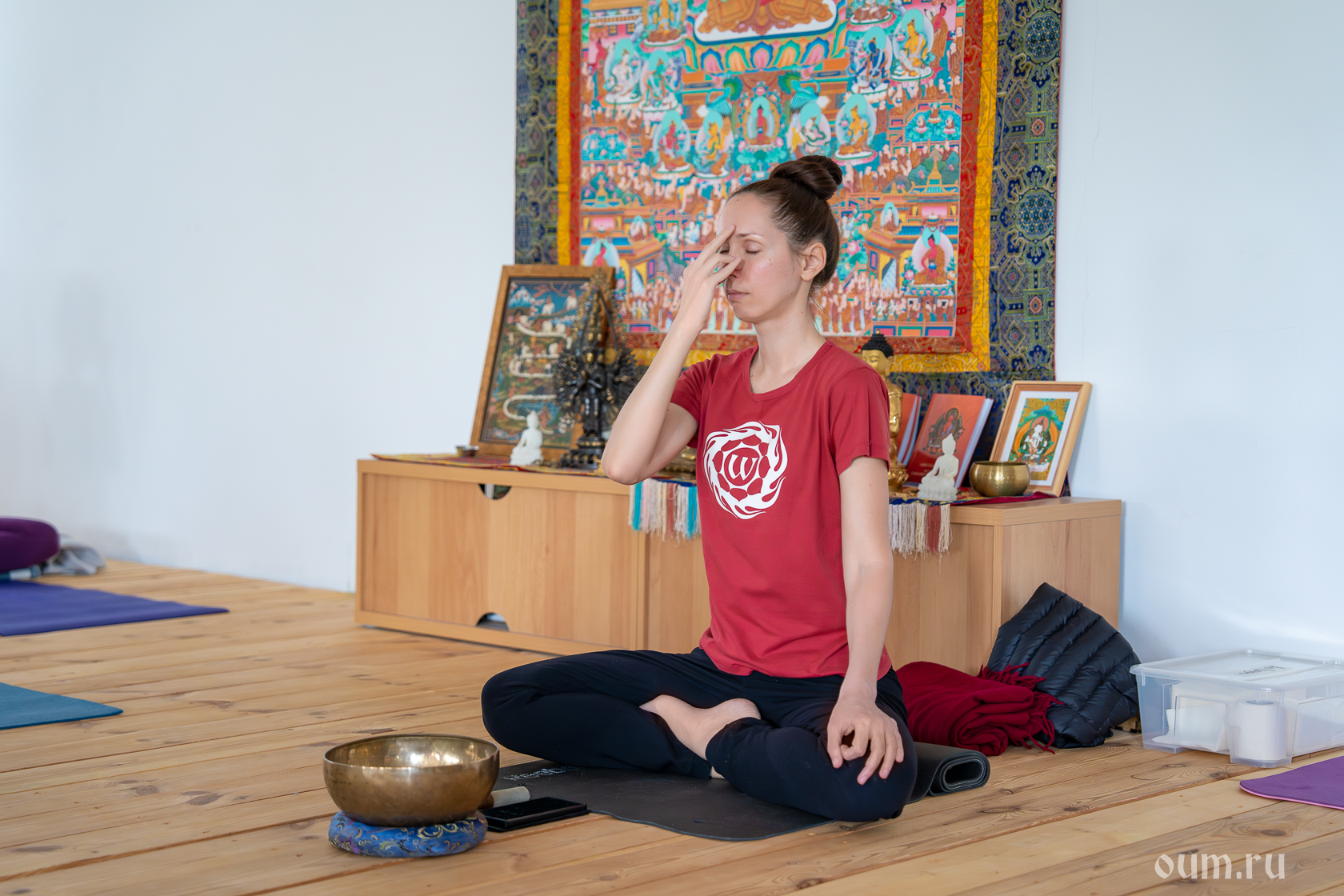
Nasagra mudra

The position of the fingers and hand is as follows:

1. Hold the right hand in front of the face (the left hand can also be used in which case the following instructions are reversed).

2. Place the tips of the second (index) and third fingers so that they rest on the forehead at the eyebrow centre.… skaityti daugiau


Samaveta Pranayama: Technique Step by Step for Beginners

The Sanskrit word samaveta means ‘together’. Therefore samaveta pranayama is a practice where one breathes through both the nostrils. This might seem to be an obvious and inconsequential statement, but the practice is so named to distinguish it from other techniques of pranayama where the flow of air is directed in one nostril by physically or mentally preventing the flow in the other nostril.

Technique

1. Sit in a comfortable position, preferably in one of the meditative asanas. The essential thing is that the spine remains erect. If necessary wrap a blanket around you if the atmosphere is cold.
2. Close the eyes.
3. Start practise yogic breathing. Try to make the movement of the abdomen and the chest as rhythmical as possible, so that as you inhale there is a wavelike motion from the abdomen to the chest and as you exhale there is a wavelike motion from the chest to the abdomen.… skaityti daugiau


Pranayama Ujjayi: Technique Step by Step for Beginners

Ujjayi pranayama is the psychic breath. It is easy to learn and can be practised by all, young and old, at any time of the day or night. You can use whatever position you find most comfortable, as long as the spine, neck and head all form a straight line.

Techniques

1. Relax your whole body and adjust your position so that you don’t have to change it at all during the practice.
2. Close your eyes.
3. Be aware of the breath flowing in and out of the nostrils.
4. Move your awareness down to your throat.
5. Feel the breath in your throat.
6. Contract the glottis.
7. Breathe deeply and softly.… skaityti daugiau


Pranayama Kapalabhati: Technique Step by Step for Beginners

Kapalabhati is a technique of pranayama, although some yogic scriptures regard it as one of the shatkarmas. It is an excellent practice that purifies the frontal portion of the brain, massages the abdominal organs and improves respiration. It is also a powerful method of waking up the mind. It can be used for energize the mind for mental work when you feel tired, and to remove sleepiness early in the morning. It is an ideal practice to do immediately before commencing meditation techniques.

The word kapala means ‘forehead’ or ‘frontal lobe of the brain’, bhati is ‘bellows’, the instrument used by a village blacksmith to create air drafts for his forge.… skaityti daugiau


Full Yogic Breathing: Technique Step by Step for Beginners

Technique

1. Inhale slowly by allowing your abdomen to expand. Try to breathe so slowly that little or no sound of breath can be heard.

2. At the end of abdominal expansion, start to expand your chest outwards and upwards. At the end of this movement draw your collarbone and shoulders towards your head. This completes 1 inhalation. The whole process should be one continuous movement, each phase of breathing merging into the next, without there being any obvious transition point. There should be no jerks or unnecessary strain. Your breathing should be like the swell of the sea. The rest of the body should be relaxed.

3. Now start to exhale.… skaityti daugiau


Pranayama: Techniques, Benefits, Types

Pranayama becomes more and more popular in the modern world. In various yoga styles, pranayama has various goals: to calm down an active mind, reach emotional balance, clean and restore the energy body and accumulate energy. By reading primal scriptures of yoga, we know that pranayama – prana energy control, a universal life force that is very related to breathing. Mastering pranayama cleans the “subtle body,” removes blocks in the energy channel system (nadi), and improves the flow of prana. Pranayama  is an instrument that actively makes an impact on our inner world. When we live a usual, regular life and interact with a huge amount of information on lower centers, consciousness has a low vibration and becomes impure and rougher.… skaityti daugiau